


Two names around a porcelain tradition: Arita names a place of making; Imari names the port through which many pieces travelled. In Europe, it was often the port’s name that endured.
Turned over, a piece reveals three surfaces where the clay remains bare: the ring on which it stands, the edge of the rim, and the hollow at the centre of the foot. On the table, none is visible.
There is nothing accidental about this detail. Glaze in those places would make the piece stick in the kiln. On Arita porcelain, the bare foot is cleaned by hand after firing, even though it comes into view only when the object is turned over.
Invisible on the table, this detail links the maker’s gesture to the viewer’s eye.
Two names along one route
Porcelain from this part of Japan has carried several names. Arita and Imari often meet in the same story, though they have not always meant exactly the same thing. A study published by the Palace Museum traces the distinction.
Arita is the town in today’s Saga Prefecture where many of these pieces were made. In Japanese ceramic names, yaki means “fired”: Arita-yaki, Imari-yaki, Karatsu-yaki. The place named, however, is not always the same kind of place.
Imari is a port. Historically, many porcelains made in Arita and neighbouring centres left through it and acquired its name. “Imari” could cover work from more than one production centre in Hizen; today it can also describe ceramics actually made in Imari.
European buyers often learned where an object had departed from before learning where it had been fired. The British Museum still describes a type of Imari porcelain as made in Arita and sold through the port of Imari. One name followed the clay; the other followed the voyage.
A war, a potter, a hill
Before the seventeenth century, Japan made earthenware and stoneware, but porcelain production was not yet established there. In the late sixteenth century, Toyotomi Hideyoshi’s invasions of Korea brought Korean potters to Japan. Their knowledge became an important part of Japan’s early porcelain industry.
One was Yi Sam-pyeong, known in Japan as Kanagae Sanbei. A tradition preserved in family records links his move to Arita in 1616 with the discovery of porcelain stone on the Izumiyama hill and the building of a kiln near Shirakawa. In 2016, Arita marked four hundred years from that date.
The date does not settle the question. Excavations at Tengu-dani do not establish with certainty that the first firings took place in 1616, and other records mention potters active in the area before him. Some historians therefore treat 1616 as a commemorative date rather than a proven beginning.
Beyond the search for a single founder, a larger change comes into view. In the early seventeenth century, kilns in this part of Kyūshū began to work local porcelain stone, and a Japanese porcelain industry took shape.


When orders changed course
In the mid-seventeenth century, the wars surrounding the Ming–Qing transition reduced Chinese porcelain exports. The maritime restrictions of 1656 deepened the disruption. For merchants supplying Europe, Japanese porcelain became another possibility.
A report collected by the Tainan city government notes a Chinese merchant exporting Arita porcelain as early as 1647, a Dutch East India Company shipment to Hanoi in 1650, and large-scale exports to the Middle East and Europe beginning in 1659. Within a few years, workshops that had mainly served nearer markets were answering distant orders.
The name Imari travelled with that trade. Many pieces departed from the port, and buyers remembered the port’s name.

The French taste for mounts
Asian porcelain was prized in eighteenth-century European interiors. In Paris, merchants had some pieces fitted with silver or gilt-bronze mounts. Metal did more than frame the ceramic body: it changed the object’s outline and its place within a room.
In 1715, Raymond Le Plat bought a Japanese porcelain service in Paris for Augustus the Strong of Saxony; it was later mounted in silver in Dresden. Later still, a pair of covered bowls made in Arita in the late seventeenth century received French gilt-bronze mounts around 1745–1750. Now at the Metropolitan Museum of Art, the bowls show the change clearly: rim, cover, and base take on another shape.
The mounts adapted porcelain to the taste of European interiors. The piece remained Japanese; the metal changed its presence. One object now carried two aesthetic choices.

From mounts to material
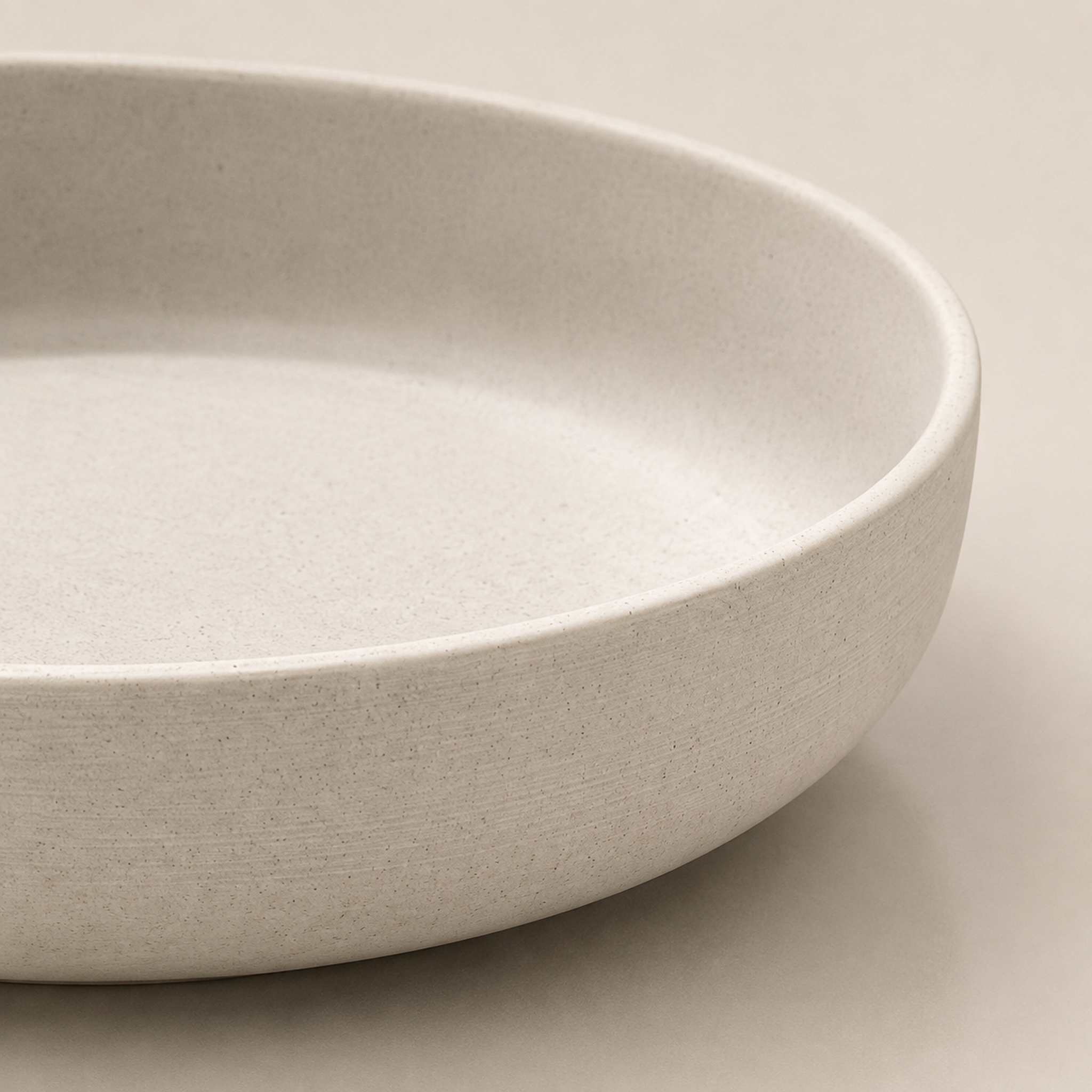
The Raw Earth collection follows another path. Made in Arita today, its pieces borrow neither the scrollwork nor the shine of historic mounts. Their grey or sand-coloured surfaces remain matte, with visible grain; the square dish also carries a woven pattern.
The space left around food becomes part of the composition. Rim, centre, and foot guide the eye; on the square dish, the woven pattern becomes part of this restrained composition. Form reveals itself in everyday use.
The foot of a piece from the Raw Earth collection is the same as that of seventeenth-century Arita porcelain: left bare for the same technical reason, it is also cleaned by hand for the same reason as before, because this hidden side may be turned over and examined closely.
What use reveals
Turned over, the piece reveals a bare foot ring, rougher than the rest and sometimes slightly different in colour: this is where it touched the kiln furniture.
At the rim, there is no painted line, no border, no repeated motif; the colour stops there.
To the touch, the surface catches slightly, like very fine paper. Its low sheen allows the intended grain to show.
In daylight, two pieces of the same shade may show subtle differences in tone and in the pattern of tiny speckles. Firing leaves slight variations in colour and surface from one piece to another.
A colour, a grain, a bare foot: the collection’s character resides in these details. Its three unglazed surfaces appear only when a piece is turned over.
History in its proper place
These pieces claim neither an ancient method nor a direct lineage from seventeenth-century kilns.
Arita’s history is not the history of the Raw Earth collection, but it illuminates the place where the pieces are made today. Their restraint is a choice for contemporary life.
Nor is this tableware presented as “traditional.” It offers a contemporary reading of that place and its objects, rather than proof of an inherited technique. The distinction lets us look at the past without assigning the collection an age that is not its own.
Explore the Raw Earth collection →
Cover image: 1904 British Admiralty chart of north-west Kyushu, including Imari Bay. Wikimedia Commons · public domain. It illustrates the geographical setting, not a seventeenth-century shipping route.
